Choosing the right elevator is an important decision for any residential or commercial building. The right elevator can improve accessibility, support convenient movement between floors, and complement the building’s design.
With modern construction focusing on convenience, accessibility, energy efficiency, and connected building technologies, property owners have more elevator options to consider. Smart elevator features and energy-saving technologies are also emerging trends in India’s elevator industry. IBEF+1
At VINI Elevators, we understand that every building has different requirements. Whether you are planning a new home, apartment complex, hospital, office, or industrial facility, selecting a suitable elevator begins with understanding your needs.
In this guide, we explore the different types of elevators, important selection factors, and the benefits of professional installation and maintenance.
1. Understand the Different Types of Elevators
Before selecting an elevator, consider the building’s purpose, available space, expected usage, and accessibility requirements.
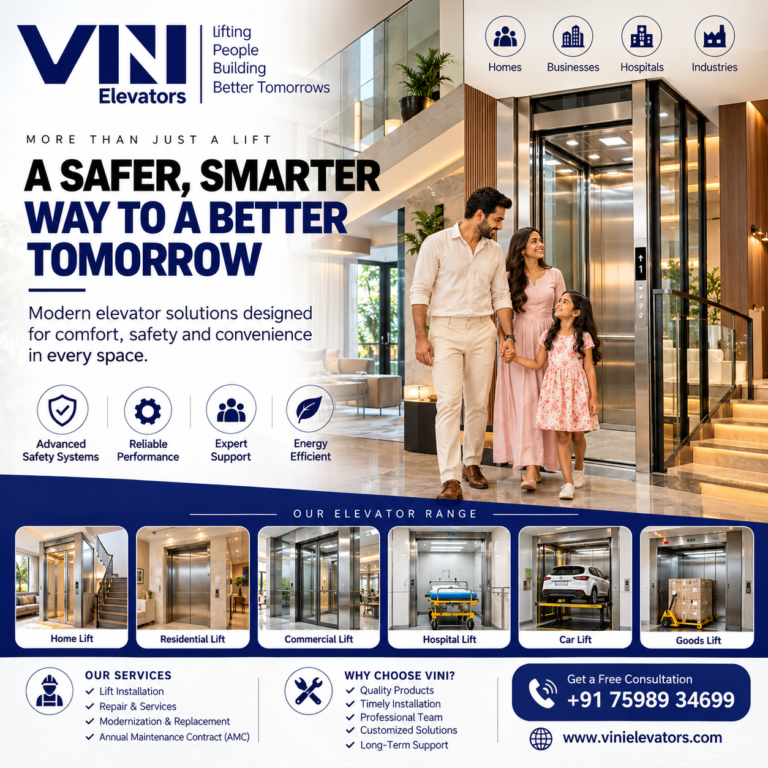
Home Lift
A home lift provides convenient movement between floors in independent houses, villas, and duplex homes. Depending on the design, it can be planned to suit available space and interior aesthetics.
Residential and Passenger Lift
Residential and passenger elevators are designed for apartments, offices, hotels, and other buildings where people need to travel between floors regularly.
Commercial Lift
Commercial elevators support movement in offices, shopping centres, hotels, and business establishments. Capacity and traffic requirements should guide the selection.
Hospital Lift
Hospital elevators must be planned around patient transport, stretcher dimensions, accessibility, and the operational requirements of healthcare facilities.
Goods and Industrial Lift
These elevators support the movement of materials, equipment, and goods in warehouses, factories, and industrial facilities. Load capacity and intended use are key considerations.
Car Lift
Car lifts help transport vehicles between levels in selected parking facilities, showrooms, and properties where conventional ramps may not be practical.
VINI Elevators also offers solutions for projects requiring hydraulic lifts, capsule lifts, freight lifts, and other specialised elevator configurations, subject to project requirements.
2. Consider These 6 Important Factors Before Buying an Elevator
Building height and available space
Determine the number of floors, shaft dimensions, pit depth, overhead clearance, and machine-room requirements. These details help establish which elevator configurations may be suitable.
Passenger capacity and usage
Estimate the number of passengers and how frequently the elevator will operate. A private residence and a busy commercial building will generally have different traffic requirements.
Safety features
Ask about door safety systems, overload protection, emergency communication, backup or rescue arrangements, and applicable safety requirements. The exact provisions depend on the elevator design and local regulations.
Energy efficiency
Discuss suitable drive systems, lighting, standby settings, and other energy-saving options. Actual energy consumption depends on the elevator model, load, travel distance, and usage pattern.
Design and customisation
Choose cabin finishes, lighting, doors, and other design elements that complement your building. Ensure that appearance does not compromise accessibility or required safety specifications.
Installation and maintenance
Evaluate the installation team’s experience, warranty terms, availability of spare parts, maintenance schedule, and after-sales support before making your decision.
3. Why Are Smart Elevator Solutions Becoming Important?
Modern building owners increasingly consider technologies that can improve elevator operation and user convenience. Industry developments include connected monitoring, predictive maintenance, touchless controls, and energy-efficient systems. Availability varies by model and manufacturer. IBEF+1
Potential benefits include:
- Monitoring certain operating conditions.
- Identifying maintenance needs earlier when supported by the system.
- Improving passenger convenience through suitable controls.
- Supporting energy-management goals.
- Helping maintenance teams assess equipment performance.
When comparing smart elevator features, ask which capabilities are actually included in the proposed model and which require additional hardware or subscriptions.
4. The Importance of Professional Elevator Installation
Elevator installation requires careful coordination between the elevator provider, architect, builder, and other relevant professionals.
A typical project involves:
- Site assessment: Review the building layout and installation requirements.
- Technical planning: Confirm capacity, dimensions, specifications, and suitable equipment.
- Installation: Complete the work according to approved plans and applicable requirements.
- Testing and commissioning: Verify operation and safety functions before handover.
- Maintenance planning: Establish inspections and servicing according to the manufacturer’s recommendations and applicable regulations.
Proper planning helps avoid preventable delays and supports the long-term performance of the installation.
5. Why Regular Elevator Maintenance Matters
Regular maintenance helps identify wear, operating issues, and components that may require attention before they develop into more serious problems.
A suitable maintenance programme may include:
- Checking doors and door interlocks.
- Inspecting operating controls and safety systems.
- Checking relevant mechanical and electrical components.
- Testing emergency communication and rescue arrangements.
- Reviewing faults and service records.
- Replacing worn components when required.
Maintenance frequency should follow the elevator manufacturer’s instructions, applicable regulations, and the actual operating conditions. Never ignore unusual noises, repeated faults, or malfunctioning doors; report them to a qualified elevator service provider.
6. How to Select the Right Elevator Company
Before choosing an elevator provider, compare more than just the initial quotation.
Look for:
- Clearly documented technical specifications.
- Suitable solutions for your building and intended usage.
- Transparent quotation and installation scope.
- Qualified installation and service personnel.
- Warranty terms and spare-parts support.
- A defined preventive-maintenance programme.
- Clear communication throughout the project.
Request a site survey and written proposal so that you can compare quotations on a like-for-like basis.
7. Why Consider VINI Elevators?
VINI Elevators provides elevator solutions for residential, commercial, healthcare, and industrial applications.
Our elevator range and services can help property owners, builders, and businesses assess solutions suited to their projects.
Our solutions include:
- Home and residential lifts
- Commercial and passenger lifts
- Hospital lifts
- Car, goods, and industrial lifts
- Specialised elevator configurations
Our services include:
- Elevator installation
- Repair and servicing
- Modernisation and replacement
- Annual Maintenance Contract (AMC)
Whether you are planning a new construction project or reviewing the requirements of an existing building, discuss your project with our team to identify a suitable solution.
Frequently Asked Questions (FAQs)
1. Which elevator is best for a home?
The best home lift depends on the number of floors, available space, passenger needs, building design, and budget. A site assessment can help identify suitable options.
2. Can an elevator be installed in an existing building?
In many cases, it may be possible, but feasibility depends on structural conditions, available space, access requirements, and applicable approvals. A professional site inspection is essential.
3. How often should an elevator be maintained?
Maintenance frequency depends on the model, usage, manufacturer’s instructions, and applicable regulations. Follow the maintenance schedule recommended for your installation.
4. What is an Annual Maintenance Contract (AMC)?
An AMC is a service agreement that defines the maintenance and support provided over a specified period. Always review the scope, exclusions, response terms, and charges before signing.
5. How can I request an elevator quotation?
Contact VINI Elevators with your building location, number of floors, intended use, and available drawings or dimensions. The team can guide you on the next steps for a project assessment.
Make Your Building Smarter with VINI Elevators
The right elevator can make a meaningful difference to the accessibility, convenience, and functionality of your building. By considering safety, capacity, design, energy efficiency, installation, and maintenance, you can make a more informed decision.
Planning an elevator for your next project? Get in touch with VINI Elevators to discuss your requirements.
- Website: www.vinielevators.com
- Phone: +91 75989 34699
VINI Elevators — Lifting People, Building Better Tomorrows.