
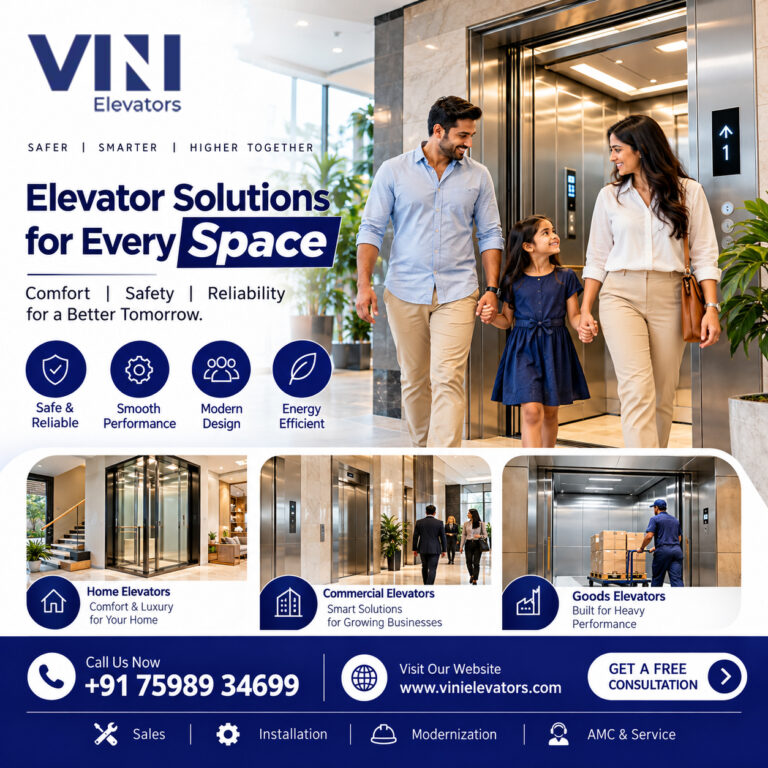
Choosing the right elevator is an important decision for any residential, commercial, or industrial building. An elevator is not only about moving people between floors—it can improve comfort, accessibility, safety, convenience, and the overall functionality of a building.
With modern buildings becoming taller and homes increasingly being designed with multiple floors, elevators are becoming an important part of both residential and commercial construction. In India, the elevator industry continues to serve a wide range of applications including passenger, home, goods, automobile and institutional elevators. Elevator World
At VINI Elevators, we focus on providing practical elevator solutions designed around the requirements of different spaces and applications.
Why Choosing the Right Elevator Matters
Every building has different requirements.
A residential villa may need a compact and comfortable home elevator, while an office building may require a reliable commercial passenger elevator. Warehouses and industrial facilities may need a goods elevator designed to handle heavier loads.
Before selecting an elevator, consider:
- Building type
- Number of floors
- Passenger requirements
- Load capacity
- Available shaft space
- Building design
- Frequency of usage
- Safety requirements
- Maintenance requirements
- Long-term operating costs
Selecting an elevator based on the actual application can help ensure better performance and usability.
1. Home Elevators – Comfort for Modern Homes
Home elevators are becoming increasingly popular in villas, duplex houses and multi-storey residential properties.
A residential elevator can make everyday movement between floors easier for families, senior citizens and people who may find stairs difficult to use.
Benefits of Home Elevators
- Comfortable movement between floors
- Improved accessibility
- Modern appearance
- Convenient for multi-storey homes
- Can complement contemporary home interiors
- Suitable for villas and independent houses
Modern residential elevator designs can also become part of the home’s overall architectural appearance rather than simply being a functional installation. Recent industry coverage highlights growing interest in residential elevators and smart features for Indian homes. Nibav Lifts
Looking for a home elevator for your villa or residence? Choosing the right design, capacity and installation approach should be based on your home’s structure and daily requirements.
2. Commercial Elevators – Designed for Busy Buildings
Commercial buildings require elevators that can handle regular passenger movement efficiently.
Offices, shopping spaces, hotels, apartment buildings and other commercial properties may experience significantly higher elevator usage than a typical home.
A commercial elevator solution should therefore be selected by considering:
- Passenger traffic
- Building height
- Travel frequency
- Capacity requirements
- Door configuration
- Building layout
- Safety and maintenance requirements
For commercial projects, working with an experienced elevator installation and service provider is important because elevator requirements should be considered during the building planning stage.
3. Goods Elevators – Built for Material Movement
Moving heavy materials manually between floors can be inefficient and physically demanding.
Goods elevators are designed for applications where materials, equipment, products and other goods need to be transported between different levels.
They can be useful for:
- Warehouses
- Manufacturing facilities
- Commercial buildings
- Shops
- Industrial facilities
- Storage areas
- Logistics operations
The appropriate goods elevator should be selected according to the required load capacity, dimensions, travel height and frequency of operation.
4. Safety Should Always Come First
An elevator is a long-term building investment, so safety should never be treated as an optional feature.
When evaluating an elevator company, customers should ask about:
- Safety systems
- Emergency provisions
- Installation practices
- Maintenance support
- Replacement parts
- Periodic servicing
- After-sales support
A professional elevator provider should clearly explain the technical and maintenance requirements before installation.
5. Elevator Installation Requires Proper Planning
Elevator installation isn’t simply about placing a cabin inside a building.
The project may involve several factors, including:
Site Survey → Building Assessment → Elevator Selection → Design & Planning → Installation → Testing → Handover → Maintenance
The available space, shaft dimensions, electrical requirements, landing arrangements and structural conditions should all be evaluated before installation.
Proper planning can help avoid unnecessary modifications and delays during the project.
6. Elevator Maintenance & AMC
Even a well-installed elevator requires regular maintenance.
Preventive maintenance can help identify potential issues before they become major problems.
An Elevator AMC (Annual Maintenance Contract) can provide scheduled service and maintenance support for buildings that depend on their elevators every day.
Common maintenance activities may include:
- Safety inspection
- Door operation checks
- Control system inspection
- Electrical checks
- Mechanical inspection
- Lubrication where applicable
- Cabin and landing inspection
- Emergency system checks
Regular maintenance is particularly important for commercial and industrial buildings where elevator downtime can affect daily operations.
7. Elevator Modernization for Existing Buildings
Older elevators may eventually require modernization.
Instead of completely replacing an elevator in every situation, modernization can involve upgrading selected components depending on the condition and design of the existing system.
Potential modernization areas can include:
- Control systems
- Door systems
- Cabin interiors
- Operating panels
- Safety systems
- Energy-efficiency improvements
A professional site assessment can determine whether modernization or replacement is more appropriate.
How to Choose the Right Elevator Company
Before choosing an elevator manufacturer, supplier or installation company, compare more than just the initial quotation.
Consider:
1. Product Quality
Understand the elevator technology, components and specifications being offered.
2. Installation Experience
Ask about previous projects and installation capabilities.
3. Safety
Understand the safety systems and testing procedures.
4. After-Sales Service
A reliable service network is important after installation.
5. Maintenance
Ask about AMC and preventive maintenance options.
6. Customization
For homes and premium commercial spaces, cabin finishes and designs may be important.
7. Total Cost of Ownership
Don’t evaluate an elevator only by its initial purchase price. Installation, electricity consumption, maintenance and modernization can affect the long-term cost.
Why VINI Elevators?
VINI Elevators provides elevator solutions for different residential, commercial and industrial requirements.
Our solutions are focused on combining:
Safety | Comfort | Reliability | Performance | Modern Design
Whether you are planning a home elevator for a villa, a commercial elevator for an office or building, or a goods elevator for material movement, selecting the right solution starts with understanding your building’s requirements.
📞 Call VINI Elevators: +91 75989 34699
🌐 Website: www.vinielevators.com
VINI Elevators – Safer | Smarter | Higher Together
Frequently Asked Questions
What type of elevator is suitable for a home?
The suitable elevator depends on the number of floors, available space, load requirement, building structure and homeowner requirements. A site assessment is recommended before selecting a system.
Are home elevators suitable for villas?
Yes. Home elevators can be considered for multi-storey houses, villas and duplex properties, depending on the available space and structural requirements.
What is a goods elevator used for?
Goods elevators are designed primarily for transporting materials and goods between different floors in commercial, warehouse and industrial environments.
How often should an elevator be maintained?
Elevators should follow a planned preventive maintenance schedule appropriate to the equipment, usage and applicable requirements. Commercial and high-usage elevators may require particularly consistent servicing.
What is elevator modernization?
Elevator modernization involves upgrading selected components of an existing elevator system to improve performance, safety, reliability or appearance, where technically appropriate.